Women's Bestsellers
How to choose midi skirt length according to height and calf shape? Measurements and tailoring adjustments
Midi skirt length is not a single fixed value. Two models described in the store as midi can end in completely different places – just below the knee, mid-calf, or a few centimeters above the ankle. It is precisely the skirt’s end point that determines whether the silhouette looks proportional and the legs maintain a light line.
When choosing length, it’s not enough to rely on the model’s height in the photo or the general information given in the product name. Also important are:
- leg length,
- knee height,
- calf shape,
- location of its widest and narrowest points,
- the skirt's waistband height,
- type of footwear,
- how the fabric lays,
- construction of the skirt’s lower part.
The best midi length can only be determined after trying on the skirt and checking several finishing variants. Sometimes shifting the lower edge by just a few centimeters significantly improves proportions.
People who are new to this type of cut can first check what midi skirt length is and why it’s so universal. This guide focuses on practical measuring, fitting to height, and assessing the possibility of shortening a specific model.
What exactly does midi length mean?
A midi skirt ends below the knee but above the ankle. This is a wide range, so the term "midi" alone is not enough to predict how the cut will look on a specific person.
In practice, three basic variants can be distinguished:
- short midi ending a few centimeters below the knee,
- classic midi reaching the middle part of the calf,
- long midi ending a few centimeters above the ankle.
The same model can look like a classic midi on a tall person and approach maxi length on a shorter silhouette. For this reason, length given in centimeters is more important than the cut name alone.
How to measure midi skirt length correctly?
The most accurate measurement is taken from the top edge of the waistband to the bottom edge of the skirt.
You will need:
- a soft tailor’s tape,
- target shoes,
- a full-length mirror,
- a well-fitting top,
- help from another person or the ability to mark the length with a pin.
Put the skirt on exactly at the height where it will be worn later. If the waistband shifts a few centimeters up or down, the skirt’s end point will also change.
Take the measurement as follows:
- Stand straight without pulling the skirt up.
- Place the waistband in the natural position.
- Measure the length from the top edge of the waistband to the bottom.
- Mark the end point on the leg.
- Compare it with the widest and narrowest points of the calf.
- Put on the target shoes.
- Check the silhouette from front, side, and back.
- Take a few steps and sit down.
It’s worth noting the length of the model that looks best. This will make later online shopping easier.
How to find the widest point of the calf?
You can find the widest point of the calf by standing sideways in front of a mirror and observing the leg line from the knee to the ankle. It is the place where the calf has the greatest circumference.
You can also measure it with a tailor’s tape:
- Measure the calf circumference at different heights.
- Note the largest measurement.
- Mark this height.
- Check if the skirt ends exactly at this point.
A bottom edge ending at the widest point of the calf creates a distinct horizontal line. It can make the leg look bulkier, especially if the fabric is stiff and the shoes strongly contrast with skin color.
This doesn’t mean every skirt ending at this point must be shortened. However, it’s worth comparing it with shorter or longer versions.
Where is the narrowest part of the calf?
The narrowest part of the calf is usually located:
- a few centimeters below the knee,
- either in the lower part of the leg, just above the ankle.
For many silhouettes, a skirt ending exactly in one of these areas looks flattering.
The first variant gives a lighter, more classic effect. The second creates a longer, calmer line and brings the cut closer to a long midi.
The choice depends on leg proportions, skirt construction, and footwear. Don’t assume a shorter version will always be better for a shorter person. Sometimes a longer midi ending above the ankle looks better than a model cutting across the calf at an unfavorable point.

How to choose midi length for a shorter height?
For shorter height, the scale of the cut is crucial. The skirt shouldn’t overwhelm the silhouette with excess fabric or end at a random point.
Usually, the following work well:
- midis ending a few centimeters below the knee,
- models revealing a slimmer part of the calf,
- longer midis ending just above the ankle,
- cuts with moderate volume,
- skirts with a distinctly marked waistband.
When trying on, it’s worth comparing at least two lengths. A model shortened by 3–5 cm can look much lighter, but this is not a rule for every silhouette.
More rules regarding specific optical effects are described in the guide: midi skirt that elongates legs – which cut, length, and details to choose.
How to choose midi length for taller height?
Tall people can usually wear both classic and long midi more freely. However, this doesn’t mean every length will look equally good.
For tall height, check:
- whether the skirt doesn’t end randomly just below the knee,
- whether the proportion between torso and leg length remains harmonious,
- whether the skirt volume doesn’t create too heavy a lower part,
- whether the cut doesn’t look like an ill-fitting maxi length.
A long midi ending a few centimeters above the ankle can look very elegant, especially in a straight, trapeze, or pleated cut.
Does midi length depend on leg length?
Yes. Two people of the same height may need different skirt lengths.
One may have:
- longer legs and a shorter torso,
- shorter legs and a longer torso,
- high-set knees,
- a longer or shorter calf.
Therefore, height alone is not sufficient information. The best reference point is the actual skirt end point on the leg.
For shorter legs, it’s especially important to ensure the waistband stays at the correct height. Even a slight skirt shift can lower the entire cut line and change proportions.
How to measure midi skirt with target footwear?
Always evaluate the skirt with the shoes it will most often be worn with.
It looks different combined with:
- ankle boots,
- ballet flats,
- loafers,
- sneakers,
- ankle boots,
- boots,
- sandals.
Shoes can elongate or visually divide the lower silhouette. Ankle boots ending near the skirt’s bottom edge create a different proportion than pumps exposing the instep.
When measuring, check:
- how much leg remains visible between skirt and shoe,
- whether the boot shaft doesn’t end near the widest calf point,
- whether the skirt’s bottom edge and the shoe’s top edge don’t create two close lines,
- whether the shoe matches the fabric’s weight.
One skirt length may look good with pumps but much worse with boots. Therefore, before tailoring, define the basic way of wearing the model.
How to check length while walking?
A skirt may look good while standing but change position in motion.
While walking, check:
- whether the front rises higher than the back,
- whether the fabric shifts around the hips,
- whether the slit opens too wide,
- whether the bottom edge remains even,
- whether the skirt doesn’t pull on tights,
- whether pleated fabric doesn’t visually change the length.
For skirts with elastic waistbands, it’s worth walking a few minutes. The waistband may gradually shift up or down, changing the cut’s end point.
How to check length while sitting?
When sitting, the skirt rises and the fabric shifts toward the hips. You need to assess not only the look but also comfort.
Sit on a chair and check:
- how high the bottom edge rises,
- whether the slit reveals too much leg,
- whether the waistband does not slip down or roll up,
- whether the fabric does not stretch tightly on the thighs,
- whether the skirt returns to its original position after standing up.
This is especially important in pencil, wrap, and front-slit styles.
When is it worth shortening a midi skirt?
Shortening can be a good solution if:
- the skirt ends exactly at the widest part of the calf,
- the style looks too heavy,
- the bottom edge conflicts with most of the shoes you own,
- the length overwhelms a short silhouette,
- the fabric lays better after tacking up a few centimeters,
- the model was designed for a significantly taller person.
Before making a decision, it’s worth temporarily tacking up the hem with heels or tailor’s tape and comparing different options.
Most often, shortening is tested by:
- 2 cm,
- 4 cm,
- 6 cm.
A slight adjustment may be enough. It’s not always necessary to shorten the skirt to just below the knee.
When is it better to lengthen a skirt?
Lengthening can improve proportions when the model ends slightly above the slimmer part of the calf but the current length looks random.
The possibility of lengthening depends on the fabric allowance at the bottom hem.
A tailor can assess:
- the width of the allowance,
- the finishing method of the bottom,
- the visibility of the old pressing line,
- the possibility of applying reinforcing tape,
- preserving the pattern or pleats.
Lengthening by a few centimeters is easier with skirts that have a wide allowance. In cheap models, the allowance is often very small or absent.
Which styles can be easily shortened?
The easiest skirts to shorten are usually:
- straight,
- pencil skirts,
- trapeze,
- skirts with an even hem,
- skirts without decorations at the bottom edge,
- skirts without complicated slits,
- skirts made of solid fabric.
More work is required for models that are:
- pleated,
- asymmetrical,
- wrap,
- with ruffles,
- with lace hems,
- embroidered at the edge,
- with wide decorative cuffs,
- with slits reaching close to the planned shortening line.
For such styles, the tailor must maintain the original construction proportions.
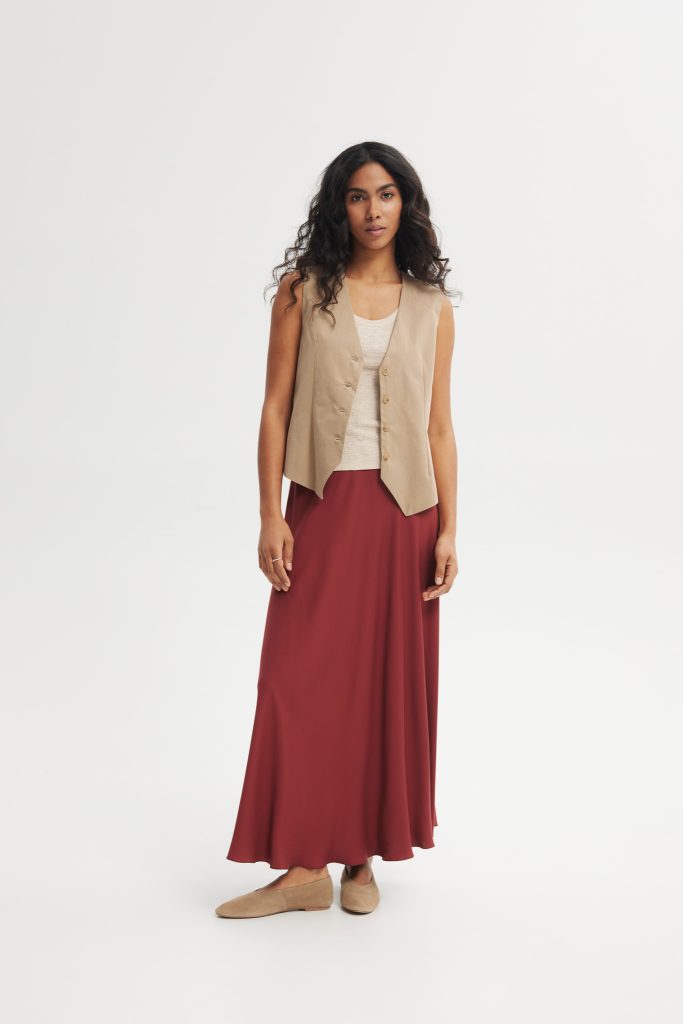
Can a pleated skirt be shortened?
Yes, but it’s not always a simple fix.
In pleated skirts, attention must be paid to:
- the method of pleat setting,
- the type of fabric,
- the width of the bottom finish,
- the possibility of re-pressing,
- the risk of pleats spreading,
- maintaining an even hem.
Some pleated skirts are shortened from the waist, not the bottom. However, this is a much more complicated alteration as it requires reattaching the waistband or elastic.
Before buying with shortening in mind, it’s best to consult the model with a tailor.
Can a skirt with a slit be shortened?
Yes, but shortening changes the proportion between the skirt length and the slit height.
After shortening, the slit may become:
- visually too high,
- too short relative to the new length,
- misaligned with the knee,
- less functional when walking.
A tailor can sometimes reduce or reconstruct the slit, but this requires extra work.
Can an asymmetrical skirt be shortened?
It can, but it requires precise recreation of the hemline. Shortening such a style on your own is risky.
It’s important to maintain:
- the difference between front and back,
- the smoothness of the slope,
- the symmetry of the sides,
- the proper fabric drape,
- the original construction line.
Before alterations, it’s best to put on the skirt and mark the new length directly on the body.
How does changing the length affect the skirt style?
Shortening a skirt doesn’t always mean just removing a piece of fabric. It can change the perception of the entire cut.
In a trapeze skirt, shortening removes the widest part of the hem, making the style appear straighter.
In a flared skirt, the circumference of the bottom edge decreases, and the fabric’s movement may change.
In a pencil skirt, shortening can shift the hem to a place where the leg has a different circumference. The skirt may become too tight or too loose at the end.
Therefore, before alterations, it’s necessary to assess not only the length but also the skirt’s width at the planned height.
How to measure a skirt before buying online?
When shopping online, the most important measurement is the total length.
Compare it with a well-fitting skirt you already own.
Do this as follows:
- Lay your skirt flat on a surface.
- Straighten the waistband.
- Measure from the top edge of the waistband to the bottom.
- Compare the result with the product’s size chart.
- Check the model’s height and the size of the skirt shown.
- Assess the waistband height.
- Check if the fabric is stretchy.
- See if the length is given for all sizes.
In some models, larger sizes may have slightly different lengths or waistband construction.
Do not base your decision solely on the photo. The model’s pose, heel height, and camera angle can alter the perception of proportions.
How to choose the midi skirt length for the style?
Pencil skirt
It should end where it doesn’t restrict movement and doesn’t cut through the widest point of the calf. For longer versions, a functional slit is important.
Trapeze skirt
It can be a bit longer if the fabric falls lightly and doesn’t create a heavy shape. Shortening changes the width of the bottom edge.
Pleated skirt
Looks good in both classic and longer versions. It’s worth checking if the bottom line doesn’t catch the eye at the widest part of the calf.
Wrap skirt
Evaluate the shortest and longest hem points. Asymmetry may leave one part of the leg more exposed.
Flared skirt
Looks best when the length works with the volume. A very long and wide midi can overwhelm a petite figure.
Choosing a cut according to proportions is described in more detail in the article: midi skirt for different silhouettes – who it suits and how to choose the right cut.
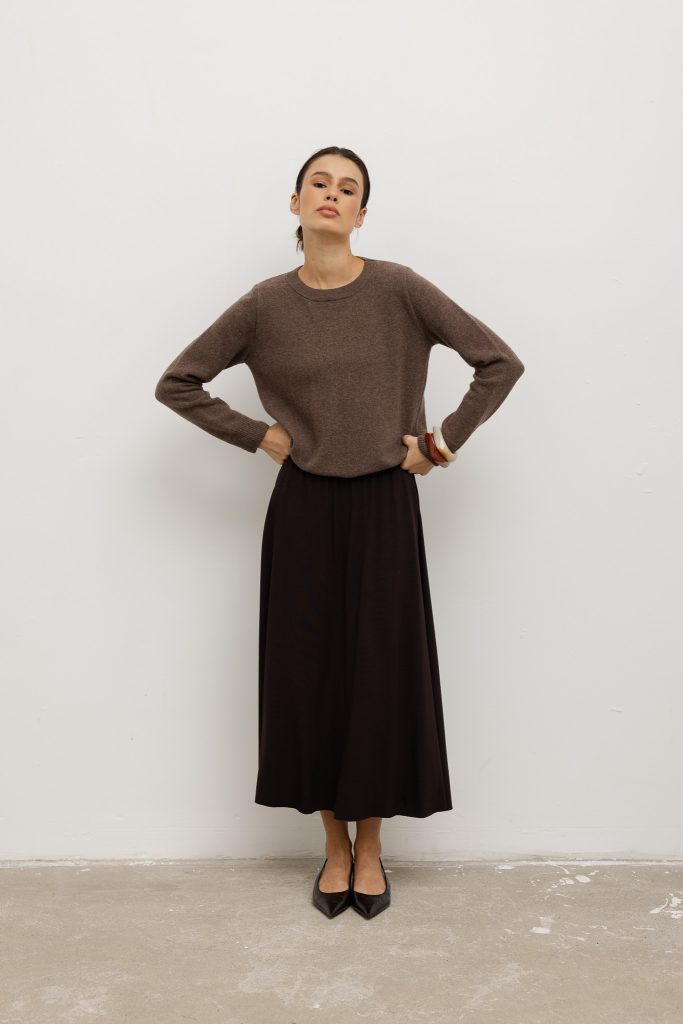
Should the waistline be considered when measuring?
Yes. The same skirt worn higher will end higher on the calf. Lowering the waistband makes it appear longer.
Before measuring, decide if the skirt will be worn:
- at the natural waist,
- slightly below the waist,
- on the hips.
It’s not worth shortening the style before the waistband is properly fitted. If the skirt gaps and slips while walking, first narrow the waistband. Only then assess the target length.
Common mistakes when choosing midi length
Judging solely by height
Height doesn’t account for leg length, knee position, or calf shape.
Buying based on the model’s photo
The model may have different proportions, wear a different size, and very high shoes.
Shortening without target shoes
Changing shoes can completely alter the perception of length.
Ignoring a shifting waistband
If the skirt slips at the waist, its length changes while wearing.
Shortening too much fabric at once
It’s safer to test several options and start with a smaller adjustment.
Ignoring slit construction
Shortening can disrupt the slit’s proportion and functionality.
No test while sitting
The skirt may ride up much higher than expected.
How to prepare a skirt for a tailor visit?
Bring:
- the skirt,
- target shoes,
- underwear or tights worn underneath,
- a top that will often be paired with the skirt.
The tailor should mark the length directly on the body. The floor must be even, and the skirt positioned naturally.
Before marking the hem, it’s worth:
- taking a few steps,
- checking the waistband,
- assessing the front and back lines,
- deciding if the length should be even,
- discussing the bottom edge finish.
For soft fabrics, it’s good to leave the skirt on a hanger before alterations. The fabric may slightly lengthen under its own weight.
How to choose the best midi length step by step?
- Decide where the skirt will be worn on the waist.
- Measure the length from the waistband to the bottom.
- Find the widest point of the calf.
- Mark slimmer spots above and below.
- Put on your target shoes.
- Compare at least two length options.
- Check the skirt while walking.
- Sit down and assess fabric movement.
- Check the hem construction, pleats, and slits.
- Evaluate the possibility of tailoring adjustments.
- Write down the best length in centimeters.
- Use this measurement for future purchases.
A well-chosen length doesn’t have to match the standard values given in guides. It should end at a place flattering to the specific leg, work with the style, and match the most frequently worn shoes.
FAQ
How to measure the length of a midi skirt?
Measure from the top edge of the waistband to the bottom edge of the skirt. The measurement should be taken with the waistband positioned at the intended height.
Where should a midi skirt end?
It usually looks good a few centimeters below the knee or at the narrowing part of the calf. The final spot depends on leg shape.
Should a midi skirt end at mid-calf?
It can, but if that’s the widest point of the calf, the bottom edge may visually widen it. It’s worth comparing shorter or longer lengths.
What midi length is best for a short person?
Often, lengths a few centimeters below the knee or just above the ankle work well. The ending point on the calf is more important than height alone.
Can a pleated midi skirt be shortened?
Yes, but the alteration may require re-finishing the pleats or shortening from the waist side. It’s best to consult the model with a tailor.
By how many centimeters should a midi skirt be shortened?
It’s best to test shorter options by 2, 4, and 6 cm. A small change often suffices to improve proportions.
Should the length be measured with shoes on?
Yes. The type of footwear affects the visible leg proportion and the perception of the skirt’s ending point.
Can a midi skirt be lengthened?
Yes, if there is enough fabric allowance at the bottom edge. A tailor should assess the possibility of lengthening.
Can you shorten a midi skirt yourself?
A simple model with an even hem can be shortened independently, but pleated, asymmetrical, wrap, and slit skirts are better left to a tailor.
How to check midi length when shopping online?
Compare the length given in the description with the length of your own well-fitting skirt, measured from the top edge of the waistband to the bottom.