Flawless trends
Midi skirts — what length are they, and why are they so versatile?
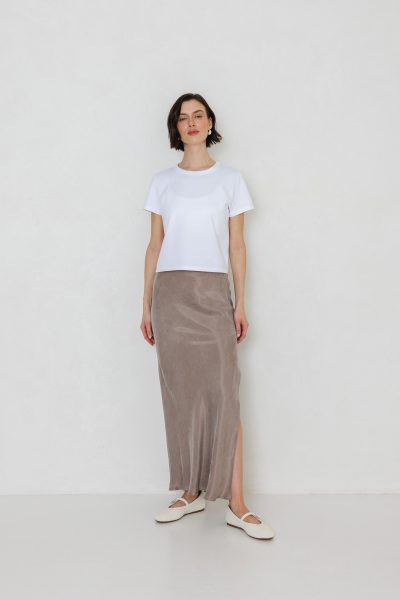
A midi skirt ends below the knee but above the ankle. In practice, it can fall anywhere from the upper calf to a few inches above the ankle. This flexibility means midi skirts come in a range of proportions, styles, and uses.
Midi is often considered one of the most versatile skirt lengths in a woman’s wardrobe. It can look formal, casual, romantic, or minimalist. It all depends on the cut, fabric, where the hem falls, and the other pieces in the outfit.
A midi skirt can be:
- pencil
- flared
- pleated
- satin,
- A-line
- knit
- denim
- wrap-style,
- asymmetrical
- circle-cut.
However, not every midi skirt will look the same on every figure. A style that ends just below the knee creates a different effect from one that falls almost to the ankle. So when choosing a skirt, look beyond the length label and pay attention to exactly where the hem falls.
Midi skirts — what exactly is the length?
There’s no single, standard midi length that applies to every skirt. It’s generally considered a style that ends:
- a few centimeters below the knee,
- at the upper part of the calf,
- mid-calf,
- on the lower calf,
- just above the ankle.
A difference of just a few centimeters can significantly change the proportions of your figure. This is because leg length, height, and calf shape vary from person to person.
The same skirt may end at mid-calf on a tall person and almost at the ankle on someone shorter. For this reason, midi shouldn’t be treated as a precise measurement in centimeters.
The most important thing is where the hem crosses the leg. It usually looks most flattering when it falls at a slimmer part of the leg, rather than exactly at the widest part of the calf.
How does midi differ from mini and maxi?
The main difference is length, but it also affects the overall feel of an outfit.
Mini skirt
A mini skirt ends above the knee. It shows more of the legs and usually has a more casual, youthful, or evening-ready feel. It may be less suitable for formal settings.
Midi skirt
A midi skirt covers the knees but leaves part of the calf or the ankle visible. It combines a more formal look with comfort and versatility for different occasions.
Maxi skirt
A maxi skirt reaches the ankles or the floor. It creates a long line, but can be more challenging when choosing shoes, outerwear, and the proportions of the overall outfit.
Midi falls between these lengths, so it often offers a balance of ease, elegance, and practicality.
Why is midi length so popular?
Midi’s popularity comes above all from how many different ways it can be worn. This length works for:
- for work,
- family gatherings,
- weddings,
- for dinner,
- everyday,
- for a walk,
- vacations,
- fall and winter outfits.
A length that covers the knees is acceptable in most professional settings. At the same time, the skirt doesn’t reach the floor, making it comfortable for walking, driving, and using stairs.
Midi skirts are also versatile because they come in so many styles. A pencil skirt can look professional, a pleated one light and romantic, and a denim one casual.
Is every midi skirt versatile?
No. Length alone doesn’t guarantee versatility.
The following affect how a skirt can be worn:
- cut,
- color,
- fabric,
- pattern,
- finishing,
- whether it has a slit,
- waistband style,
- level of sheen,
- material volume.
The most versatile styles are usually:
- in a solid color,
- with moderate volume,
- with a defined waist,
- made of matte fabric,
- without highly seasonal details,
- easy to pair with several types of shoes.
A skirt with a large sequin pattern or dramatic ruffles may be midi length, but it won’t be as versatile as a simple style in navy, black, beige, or chocolate brown.
Where should a midi skirt end?
The most flattering hemline depends on your legs and the look you want to achieve.
Just below the knee
This length is formal and practical. It works well for pencil and A-line skirts. It reveals more of the calf, which can make the silhouette look lighter.
At the upper calf
This length is common in flared skirts. It can show off your shoes, but the hem should fall at a slimmer part of the leg.
At mid-calf
This is the classic midi length, but it can be more challenging to wear. If the hem falls at the widest part of the calf, it may make the legs look shorter or wider.
Just above the ankle
This skirt falls close to the boundary between midi and maxi. It creates a longer line and can look elegant, but the proportions of the top and shoes need to be right.
It’s best to try on a few lengths and see how they look with the shoes you’ll wear most often.
If your main goal is to make your legs look slimmer, also check how to choose the length and cut of a midi skirt to create a more streamlined silhouette. In this case, it’s not only the skirt’s hemline that matters, but also the rise, the placement of the seams, and the way the fabric drapes.
Midi Pencil Skirt
A midi pencil skirt is fitted through the hips and tapers toward the hem or falls straight. It usually ends just below the knee or at the upper calf.
It works well with:
- in the office,
- at business meetings,
- during celebrations,
- for formal outfits.
It should allow you to walk comfortably, so it often has a slit at the back, side, or front.
The most versatile styles are made from medium-weight fabric that isn’t see-through and doesn’t ride up as you move.
Flared midi skirt
A flared skirt widens from the waist or hips. It may be cut as a full or half circle, or have an A-line shape.
This type of skirt:
- emphasizes the waist,
- allows freedom of movement,
- can balance broader shoulders,
- works for both special occasions and everyday wear,
- looks great in motion.
The volume should suit the fabric. A stiff fabric creates a more defined shape, while a soft one gives the skirt a fluid look.
Pleated midi skirt
The pleated midi is one of the most recognizable styles in this length. Vertical pleats can make the silhouette look longer, but how they fall depends on the fabric’s quality and the waistband construction.
When choosing, it's worth checking:
- whether the pleats spread open over the hips,
- if the fabric is not see-through,
- whether the lining is the right length,
- if the waistband stays in place,
- whether the skirt clings due to static.
A pleated midi can look elegant with a shirt and blazer or more casual with a sweater and flat shoes.
Choosing a top depends, among other things, on the width of the pleats and the height of the waistband. For more specific outfit ideas, see our guide explaining what blouse to wear with a pleated midi skirt.
Satin Midi Skirt
A satin midi skirt has a fluid, softly shimmering fabric and usually a straight or slightly flared cut.
It works well:
- for evening outings,
- for special occasions,
- with outfits featuring a blazer,
- in everyday outfits with knitwear.
The sheen catches the light, so it can emphasize the hips, creases, and underwear lines. Choose a fabric with a suitable weight, and check how it looks when walking and sitting.
Satin skirts in understated colors such as black, navy, chocolate brown, olive, beige, and ecru are the most versatile.
The sheen of satin calls for a considered choice of the other pieces. For practical outfit ideas, see our guide on what blouse to wear with a satin skirt to create a polished, elegant look.
If you want to wear this style not only in the evening but also for everyday and office outfits, see our guide: satin midi skirt: how to wear it every day, to work, and in the evening.
A-line midi skirt
An A-line cut gradually widens from the hips toward the hem. It has less volume than a full-circle skirt, making it easy to wear for everyday and office outfits.
It looks good with:
- with a shirt,
- a simple blouse,
- a thin turtleneck,
- a fitted top,
- with a shorter sweater.
An A-line midi can be a good choice if you don’t want a very fitted skirt or one with a lot of flare.
Wrap midi skirt
A wrap midi has overlapping layers of fabric. It creates a diagonal line and often allows you to adjust the waist.
Its advantages are:
- the option to emphasize the waist,
- freedom of movement,
- an interesting front line,
- suitability for both everyday and more elegant outfits.
Check that the fabric doesn’t gape too much when sitting or walking. The overlapping layers should provide enough coverage.
Denim Midi Skirt
A denim midi skirt has a more casual feel. It can be straight, A-line, pencil, or flared.
The most versatile are models:
- without large abrasions,
- in a solid color,
- with a simple slit,
- of moderate length,
- made from denim that isn’t too stiff.
A denim skirt pairs well with a shirt, T-shirt, sweater, jacket, or less formal blazer.
Is a midi skirt suitable for work?
Yes. Midi is one of the safest lengths for a professional setting.
The best choices are:
- pencil skirts,
- trapeze styles,
- pleated skirts with moderate volume,
- styles made from suiting fabric,
- solid colors,
- subtle patterns.
A skirt for work should:
- cover the knees when standing and sitting,
- not be see-through,
- not have too high a slit,
- allow you to walk comfortably,
- work well with a blazer and formal shoes.
You can pair it with elegant women’s blouses, a shirt, a lightweight sweater, or a simple top under a blazer.
Find more practical tips in our guide: midi skirts for work: which cut, fabric, and length suit an office dress code.
Is a midi skirt suitable for a wedding?
Yes. Good options for a wedding include:
- satin skirts,
- pleated,
- flared,
- asymmetrical,
- models with subtle shine.
The overall look depends on the top, shoes, and accessories. A midi skirt can take the place of a dress, especially when paired with an elegant blouse or top and a blazer.
Avoid fabrics that crease very easily and cuts that restrict movement while dancing.
Midi skirt for everyday wear
An everyday midi skirt can be made from:
- cotton,
- denim,
- knit fabric,
- viscose,
- linen,
- lyocell.
You can pair it with a simple T-shirt, shirt, sweater, or lightweight jacket. The shoes don’t need to be elegant. Depending on the cut, sneakers, loafers, ballet flats, sandals, and ankle boots can all work.
The most practical styles are those that don't need ironing after every wear and can be easily paired with a few different tops.
Spring midi skirt
In spring, these work well:
- pleated midi skirts,
- trapeze styles,
- viscose models,
- denim skirts,
- lightweight suiting fabrics.
You can pair them with a shirt, lightweight sweater, cropped blazer, or transitional jacket.
Practical colors include:
- navy,
- beige,
- light gray,
- light blue,
- olive,
- ecru.
Summer midi skirt
In summer, it's worth choosing breathable fabrics:
- linen,
- viscose,
- lyocell,
- cotton,
- light blends.
The skirt should be made in a way that allows air to circulate freely. For light colors, check for sheerness and make sure the lining is long enough.
Summer midi skirts pair well with sandals, espadrilles, lightweight loafers, and minimalist sneakers.
Midi skirts for fall
In autumn, midi can be worn with:
- a turtleneck,
- a sweater,
- with a shirt,
- a blazer,
- a coat,
- ankle boots,
- knee-high boots.
Medium-weight fabrics, denim, knitwear, suiting fabric, and wool blends all work well.
Make sure the coat doesn’t end awkwardly just a few centimeters above the skirt’s wide hem. The layers should look clearly defined.
Midi skirt in winter
In winter, you can choose:
- knit midi skirts,
- skirts with wool,
- lined models,
- styles made from thicker suiting fabric,
- leather or leather-look skirts.
Tights, knee-high boots, ankle boots, a turtleneck, and a coat all work well with this outfit.
Plain women’s sweaters look best partially tucked into the waistband, or choose a style that ends at the waist to keep the proportions balanced.
For cooler-weather outfits, the color and thickness of your tights also matter, so take a look at our guide: what tights to wear with a midi skirt: color, thickness, and how to match them with your shoes.
Does midi length suit short women?
Yes. Being short doesn’t rule out midi skirts.
The most important factors are:
- the ending point,
- waist height,
- color scheme,
- volume of the style,
- type of footwear,
- top length.
For shorter stature, the following models often work well:
- high-waisted,
- ending in the slimmer part of the calf,
- with moderate volume,
- in a solid color,
- paired with footwear that reveals the instep.
There's no need to give up pleats or flares, but it's worth adjusting the scale of the style to the figure.
Can midi shorten the legs?
Yes, especially if it ends exactly at the widest part of the calf and is paired with chunky, contrasting shoes.
You can minimize the shortening effect by:
- choosing a high waist,
- emphasizing the waist,
- wearing shoes in the color of the skin or skirt,
- revealing the instep,
- choosing a slim toe,
- avoiding wide straps around the ankle,
- creating a tonal outfit.
The entire composition matters, not just the skirt length.
Does a midi skirt suit tall women?
Yes. Tall people can wear styles that end at mid-calf as well as those that fall almost to the ankle.
Tall people can more easily wear:
- strongly flared styles,
- wide pleats,
- bold patterns,
- heavier fabrics,
- footwear contrasting with the skirt.
However, proportions and the ending point of the fabric should still be monitored.
How to choose a midi style for your figure?
For a clearly defined waist
The following work well:
- pencil midi skirts,
- circle skirts,
- wrap models,
- skirts with a wide waistband.
For wider hips
You can choose:
- a trapeze skirt,
- A-line style,
- softly draping midi,
- models with a smooth waistband.
For a straighter figure
The following may look good:
- pleated skirts,
- models with pleats,
- flared styles,
- belts emphasizing the waist.
For a fuller midsection
It's worth checking:
- medium or high waist,
- a flat waistband,
- trapeze style,
- vertical seams,
- models without large gathers at the belly.
However, there is no mandatory style for a given body type. The most important is comfort and proper fabric draping.
What top goes with a midi skirt?
The choice of top depends on the skirt’s cut.
These work well with flared and pleated styles:
- blouses tucked in,
- fitted tops,
- thin turtlenecks,
- shorter sweaters.
For pencil midi skirts, you can choose:
- a shirt,
- a wrap blouse,
- a blazer,
- a looser top partially tucked in.
Well-cut women’s shirts let you wear the same skirt for both office and everyday outfits.
What blazer goes with a midi skirt?
The blazer should work with the height of the waist and the volume of the skirt.
Good choices are:
- shorter styles emphasizing the waist,
- tailored models,
- longer blazers worn open,
- soft blazers for casual outfits,
- structured models for the office.
With a flared skirt, be careful with blazers that end exactly at the widest part of the hips.
The right women’s blazers can make even a simple, casual midi skirt look more formal.
The same principle applies to coats in fall and winter. The coat’s length shouldn’t compete awkwardly with the skirt’s hemline. Find detailed examples in our guide: what coat to wear with a midi skirt and how to choose the right coat length for your figure.
What shoes go with a midi skirt?
The following suit midi length:
- pumps,
- loafers,
- ballet flats,
- sandals,
- sneakers,
- ankle boots,
- knee-high boots.
The most important is the skirt's ending point and the height of the boot shaft.
An ankle boot shouldn’t create an awkward gap between its top and the skirt’s hem. Knee-high boots can be hidden under the fabric, creating a cleaner leg line.
Shoes revealing the instep usually add lightness to the outfit.
Find more detailed examples in our guide: what shoes to wear with a midi skirt: choosing footwear to suit the cut, length, and occasion.
What colors of midi skirts are the most versatile?
The easiest colors to use are:
- black,
- navy,
- beige,
- graphite,
- chocolate,
- taupe,
- olive,
- ecru.
Choose a color that works with several tops, shoes, and outerwear pieces.
A black midi looks more formal. Navy is a softer alternative. Beige, taupe, and ecru give outfits a lighter feel, while chocolate brown works well with a warmer wardrobe palette.
Is a patterned midi skirt versatile?
It can be, if the pattern is understated and easy to pair with other pieces.
The most practical are:
- small checks,
- vertical stripes,
- delicate florals,
- polka dots,
- tonal patterns,
- subtle herringbone.
Large, high-contrast prints are more distinctive and can go out of style more quickly.
It’s best to pair a patterned skirt with a plain top in a color that appears in the print.
How to choose your first midi skirt?
Your first style should be as versatile as possible.
It’s worth choosing:
- a neutral color,
- a simple or slightly trapeze cut,
- medium-weight fabric,
- a comfortable waistband,
- a length ending in a flattering part of the calf,
- a model that matches at least three pairs of shoes.
Before buying, check whether the skirt works with the clothes already in your wardrobe.
In the women’s skirts category, you’ll find both everyday and more elegant styles, but a product’s appearance shouldn’t be the only factor in your choice.
How to check a midi skirt when trying it on?
- Stand straight and check the ending point.
- Take a few steps.
- Sit down.
- Assess if the fabric doesn't ride up excessively.
- Check the slit height.
- See if the waistband stays in place.
- Check the fabric under light.
- Assess the lining's fit.
- Try the skirt with your intended footwear.
- Check it with a blouse tucked in and worn out.
Common mistakes when choosing midi
Relying solely on the length name
Two skirts labeled midi may end in completely different places.
Ending at the widest part of the calf
Can visually widen and shorten the leg.
Mismatch with footwear
Length should be evaluated together with shoes.
Too thin fabric
May be see-through and highlight underwear lines.
Excess volume
Very wide skirt combined with a long, loose top can overwhelm the figure.
Inappropriate lining length
Too short lining may create a visible cut under the fabric.
Limiting to one type of styling
It's worth checking midi's versatility by pairing it with several tops and pairs of shoes.
Is midi the most versatile length?
For many women, yes, because it combines formality with comfort and can be worn throughout the year. However, it isn’t automatically the best choice for everyone or every occasion.
Its versatility depends on:
- the proper ending point,
- the right style,
- neutral color scheme,
- practical fabric,
- the ability to combine with different shoes,
- matching lifestyle.
A well-chosen midi can function in a wardrobe for many seasons. Depending on accessories, it can be worn to work, events, daily, and in autumn-winter sets.
FAQ
Midi skirt – what length is it?
Midi ends below the knee and before the ankle. It can reach from the upper part of the calf to just above the ankle.
Does midi suit short women?
Yes. It's best to pay attention to a high waist, moderate volume, and an ending point in the slimmer part of the leg.
Does a midi skirt shorten legs?
It can visually shorten them if it ends at the widest part of the calf or is worn with contrasting, heavy footwear.
Is midi suitable for the office?
Yes. Pencil, trapeze, and pleated models in calm colors work especially well.
Which midi skirt is the most versatile?
The most versatile is a model in a neutral color, with a simple or slightly trapeze cut, made from medium-weight fabric.
What shoes go with midi?
Pumps, loafers, ballet flats, sandals, sneakers, ankle boots, and knee-high boots suit midi skirts. The choice depends on the style and skirt's ending point.
Can midi be worn in winter?
Yes. Just choose thicker fabric, tights, knee-high boots or ankle boots, and appropriate outerwear.
What top suits a midi skirt?
Shirts, blouses, tops, turtlenecks, thin sweaters, and blazers work well. For a wide skirt, it's worth emphasizing the waist.
How does midi differ from maxi?
Midi ends before the ankle, while maxi reaches the ankles or floor.
Is a pleated midi timeless?
It can be timeless if it has a calm color, durable pleats, and good-quality fabric.
Is every midi skirt versatile?
No. Length alone doesn’t guarantee versatility.
The following affect how a skirt can be worn:
- cut,
- color,
- fabric,
- pattern,
- finishing,
- whether it has a slit,
- waistband style,
- level of sheen,
- material volume.
The most versatile styles are usually:
- in a solid color,
- with moderate volume,
- with a defined waist,
- made of matte fabric,
- without highly seasonal details,
- easy to pair with several types of shoes.
A skirt with a large sequin pattern or dramatic ruffles may be midi length, but it won’t be as versatile as a simple style in navy, black, beige, or chocolate brown.
Where should a midi skirt end?
The most flattering hemline depends on your legs and the look you want to achieve.
Just below the knee
This length is formal and practical. It works well for pencil and A-line skirts. It reveals more of the calf, which can make the silhouette look lighter.
At the upper calf
This length is common in flared skirts. It can show off your shoes, but the hem should fall at a slimmer part of the leg.
At mid-calf
This is the classic midi length, but it can be more challenging to wear. If the hem falls at the widest part of the calf, it may make the legs look shorter or wider.
Just above the ankle
This skirt falls close to the boundary between midi and maxi. It creates a longer line and can look elegant, but the proportions of the top and shoes need to be right.
It’s best to try on a few lengths and see how they look with the shoes you’ll wear most often.
Midi Pencil Skirt
A midi pencil skirt is fitted through the hips and tapers toward the hem or falls straight. It usually ends just below the knee or at the upper calf.
It works well with:
- in the office,
- at business meetings,
- during celebrations,
- for formal outfits.
It should allow you to walk comfortably, so it often has a slit at the back, side, or front.
It’s worth choosing the height and placement of this detail carefully, which is why we cover it separately: midi skirts with slits: how to choose the height, placement, and cut.
The most versatile styles are made from medium-weight fabric that isn’t see-through and doesn’t ride up as you move.
Flared midi skirt
A flared skirt widens from the waist or hips. It may be cut as a full or half circle, or have an A-line shape.
This type of skirt:
- emphasizes the waist,
- allows freedom of movement,
- can balance broader shoulders,
- works for both special occasions and everyday wear,
- looks great in motion.
The volume should suit the fabric. A stiff fabric creates a more defined shape, while a soft one gives the skirt a fluid look.
Pleated midi skirt
The pleated midi is one of the most recognizable styles in this length. Vertical pleats can make the silhouette look longer, but how they fall depends on the fabric’s quality and the waistband construction.
When choosing, it's worth checking:
- whether the pleats spread open over the hips,
- if the fabric is not see-through,
- whether the lining is the right length,
- if the waistband stays in place,
- whether the skirt clings due to static.
A pleated midi can look elegant with a shirt and blazer or more casual with a sweater and flat shoes.
Satin Midi Skirt
A satin midi skirt has a fluid, softly shimmering fabric and usually a straight or slightly flared cut.
It works well:
- for evening outings,
- for special occasions,
- with outfits featuring a blazer,
- in everyday outfits with knitwear.
The sheen catches the light, so it can emphasize the hips, creases, and underwear lines. Choose a fabric with a suitable weight, and check how it looks when walking and sitting.
Satin skirts in understated colors such as black, navy, chocolate brown, olive, beige, and ecru are the most versatile.
A-line midi skirt
An A-line cut gradually widens from the hips toward the hem. It has less volume than a full-circle skirt, making it easy to wear for everyday and office outfits.
It looks good with:
- with a shirt,
- a simple blouse,
- a thin turtleneck,
- a fitted top,
- with a shorter sweater.
An A-line midi can be a good choice if you don’t want a very fitted skirt or one with a lot of flare.
Wrap midi skirt
A wrap midi has overlapping layers of fabric. It creates a diagonal line and often allows you to adjust the waist.
Its advantages are:
- the option to emphasize the waist,
- freedom of movement,
- an interesting front line,
- suitability for both everyday and more elegant outfits.
Check that the fabric doesn’t gape too much when sitting or walking. The overlapping layers should provide enough coverage.
Denim Midi Skirt
A denim midi skirt has a more casual feel. It can be straight, A-line, pencil, or flared.
The most versatile are models:
- without large abrasions,
- in a solid color,
- with a simple slit,
- of moderate length,
- made from denim that isn’t too stiff.
A denim skirt pairs well with a shirt, T-shirt, sweater, jacket, or less formal blazer.

Is a midi skirt suitable for work?
Yes. Midi is one of the safest lengths for a professional setting.
The best choices are:
- pencil skirts,
- trapeze styles,
- pleated skirts with moderate volume,
- styles made from suiting fabric,
- solid colors,
- subtle patterns.
A skirt for work should:
- cover the knees when standing and sitting,
- not be see-through,
- not have too high a slit,
- allow you to walk comfortably,
- work well with a blazer and formal shoes.
You can pair it with elegant women’s blouses, a shirt, a lightweight sweater, or a simple top under a blazer.
Is a midi skirt suitable for a wedding?
Yes. Good options for a wedding include:
- satin skirts,
- pleated,
- flared,
- asymmetrical,
- models with subtle shine.
The overall look depends on the top, shoes, and accessories. A midi skirt can take the place of a dress, especially when paired with an elegant blouse or top and a blazer.
Avoid fabrics that crease very easily and cuts that restrict movement while dancing.
Midi skirt for everyday wear
An everyday midi skirt can be made from:
- cotton,
- denim,
- knit fabric,
- viscose,
- linen,
- lyocell.
You can pair it with a simple T-shirt, shirt, sweater, or lightweight jacket. The shoes don’t need to be elegant. Depending on the cut, sneakers, loafers, ballet flats, sandals, and ankle boots can all work.
The most practical styles are those that don't need ironing after every wear and can be easily paired with a few different tops.
Spring midi skirt
In spring, these work well:
- pleated midi skirts,
- trapeze styles,
- viscose models,
- denim skirts,
- lightweight suiting fabrics.
You can pair them with a shirt, lightweight sweater, cropped blazer, or transitional jacket.
Practical colors include:
- navy,
- beige,
- light gray,
- light blue,
- olive,
- ecru.
Summer midi skirt
In summer, it's worth choosing breathable fabrics:
- linen,
- viscose,
- lyocell,
- cotton,
- light blends.
The skirt should be made in a way that allows air to circulate freely. For light colors, check for sheerness and make sure the lining is long enough.
Summer midi skirts pair well with sandals, espadrilles, lightweight loafers, and minimalist sneakers.
Midi skirts for fall
In autumn, midi can be worn with:
- a turtleneck,
- a sweater,
- with a shirt,
- a blazer,
- a coat,
- ankle boots,
- knee-high boots.
Layer lengths and outerwear need particular attention. Too many hems at a similar level can visually divide the silhouette, so it’s worth checking how to style a midi skirt on cooler days.
Medium-weight fabrics, denim, knitwear, suiting fabric, and wool blends all work well.
Make sure the coat doesn’t end awkwardly just a few centimeters above the skirt’s wide hem. The layers should look clearly defined.

Midi skirt in winter
In winter, you can choose:
- knit midi skirts,
- skirts with wool,
- lined models,
- styles made from thicker suiting fabric,
- leather or leather-look skirts.
Tights, knee-high boots, ankle boots, a turtleneck, and a coat all work well with this outfit.
Plain women’s sweaters look best partially tucked into the waistband, or choose a style that ends at the waist to keep the proportions balanced.
Does midi length suit short women?
Yes. Being short doesn’t rule out midi skirts.
The most important factors are:
- the ending point,
- waist height,
- color scheme,
- volume of the style,
- type of footwear,
- top length.
For shorter stature, the following models often work well:
- high-waisted,
- ending in the slimmer part of the calf,
- with moderate volume,
- in a solid color,
- paired with footwear that reveals the instep.
There's no need to give up pleats or flares, but it's worth adjusting the scale of the style to the figure.
Can midi shorten the legs?
Yes, especially if it ends exactly at the widest part of the calf and is paired with chunky, contrasting shoes.
You can minimize the shortening effect by:
- choosing a high waist,
- emphasizing the waist,
- wearing shoes in the color of the skin or skirt,
- revealing the instep,
- choosing a slim toe,
- avoiding wide straps around the ankle,
- creating a tonal outfit.
The entire composition matters, not just the skirt length.
Does a midi skirt suit tall women?
Yes. Tall people can wear styles that end at mid-calf as well as those that fall almost to the ankle.
Tall people can more easily wear:
- strongly flared styles,
- wide pleats,
- bold patterns,
- heavier fabrics,
- footwear contrasting with the skirt.
However, proportions and the ending point of the fabric should still be monitored.
How to choose a midi style for your figure?
For a clearly defined waist
The following work well:
- pencil midi skirts,
- circle skirts,
- wrap models,
- skirts with a wide waistband.
For wider hips
You can choose:
- a trapeze skirt,
- A-line style,
- softly draping midi,
- models with a smooth waistband.
For a straighter figure
The following may look good:
- pleated skirts,
- models with pleats,
- flared styles,
- belts emphasizing the waist.
For a fuller midsection
It's worth checking:
- medium or high waist,
- a flat waistband,
- trapeze style,
- vertical seams,
- models without large gathers at the belly.
However, there is no mandatory style for a given body type. The most important is comfort and proper fabric draping.
What top goes with a midi skirt?
The choice of top depends on the skirt’s cut.
These work well with flared and pleated styles:
- blouses tucked in,
- fitted tops,
- thin turtlenecks,
- shorter sweaters.
For pencil midi skirts, you can choose:
- a shirt,
- a wrap blouse,
- a blazer,
- a looser top partially tucked in.
Well-cut women’s shirts let you wear the same skirt for both office and everyday outfits.
What blazer goes with a midi skirt?
The blazer should work with the height of the waist and the volume of the skirt.
Good choices are:
- shorter styles emphasizing the waist,
- tailored models,
- longer blazers worn open,
- soft blazers for casual outfits,
- structured models for the office.
With a flared skirt, be careful with blazers that end exactly at the widest part of the hips.
The right women’s blazers can make even a simple, casual midi skirt look more formal.
What shoes go with a midi skirt?
The following suit midi length:
- pumps,
- loafers,
- ballet flats,
- sandals,
- sneakers,
- ankle boots,
- knee-high boots.
The most important is the skirt's ending point and the height of the boot shaft.
An ankle boot shouldn’t create an awkward gap between its top and the skirt’s hem. Knee-high boots can be hidden under the fabric, creating a cleaner leg line.
Shoes revealing the instep usually add lightness to the outfit.
What colors of midi skirts are the most versatile?
The easiest colors to use are:
- black,
- navy,
- beige,
- graphite,
- chocolate,
- taupe,
- olive,
- ecru.
Choose a color that works with several tops, shoes, and outerwear pieces.
A black midi looks more formal. Navy is a softer alternative. Beige, taupe, and ecru give outfits a lighter feel, while chocolate brown works well with a warmer wardrobe palette.
Is a patterned midi skirt versatile?
It can be, if the pattern is understated and easy to pair with other pieces.
The most practical are:
- small checks,
- vertical stripes,
- delicate florals,
- polka dots,
- tonal patterns,
- subtle herringbone.
Large, high-contrast prints are more distinctive and can go out of style more quickly.
It’s best to pair a patterned skirt with a plain top in a color that appears in the print.
How to choose your first midi skirt?
Your first style should be as versatile as possible.
It’s worth choosing:
- a neutral color,
- a simple or slightly trapeze cut,
- medium-weight fabric,
- a comfortable waistband,
- a length ending in a flattering part of the calf,
- a model that matches at least three pairs of shoes.
Before buying, check whether the skirt works with the clothes already in your wardrobe.
In the women’s skirts category, you’ll find both everyday and more elegant styles, but a product’s appearance shouldn’t be the only factor in your choice.
How to check a midi skirt when trying it on?
- Stand straight and check the ending point.
- Take a few steps.
- Sit down.
- Assess if the fabric doesn't ride up excessively.
- Check the slit height.
- See if the waistband stays in place.
- Check the fabric under light.
- Assess the lining's fit.
- Try the skirt with your intended footwear.
- Check it with a blouse tucked in and worn out.
Common mistakes when choosing midi
Relying solely on the length name
Two skirts labeled midi may end in completely different places.
Ending at the widest part of the calf
Can visually widen and shorten the leg.
Mismatch with footwear
Length should be evaluated together with shoes.
Too thin fabric
May be see-through and highlight underwear lines.
Excess volume
Very wide skirt combined with a long, loose top can overwhelm the figure.
Inappropriate lining length
Too short lining may create a visible cut under the fabric.
Limiting to one type of styling
It's worth checking midi's versatility by pairing it with several tops and pairs of shoes.
Is midi the most versatile length?
For many women, yes, because it combines formality with comfort and can be worn throughout the year. However, it isn’t automatically the best choice for everyone or every occasion.
Its versatility depends on:
- the proper ending point,
- the right style,
- neutral color scheme,
- practical fabric,
- the ability to combine with different shoes,
- matching lifestyle.
A well-chosen midi can function in a wardrobe for many seasons. Depending on accessories, it can be worn to work, events, daily, and in autumn-winter sets.
FAQ
Midi skirt – what length is it?
Midi ends below the knee and before the ankle. It can reach from the upper part of the calf to just above the ankle.
Does midi suit short women?
Yes. It's best to pay attention to a high waist, moderate volume, and an ending point in the slimmer part of the leg.
Does a midi skirt shorten legs?
It can visually shorten them if it ends at the widest part of the calf or is worn with contrasting, heavy footwear.
Is midi suitable for the office?
Yes. Pencil, trapeze, and pleated models in calm colors work especially well.
Which midi skirt is the most versatile?
The most versatile is a model in a neutral color, with a simple or slightly trapeze cut, made from medium-weight fabric.
What shoes go with midi?
Pumps, loafers, ballet flats, sandals, sneakers, ankle boots, and knee-high boots suit midi skirts. The choice depends on the style and skirt's ending point.
Can midi be worn in winter?
Yes. Just choose thicker fabric, tights, knee-high boots or ankle boots, and appropriate outerwear.
What top suits a midi skirt?
Shirts, blouses, tops, turtlenecks, thin sweaters, and blazers work well. For a wide skirt, it's worth emphasizing the waist.
How does midi differ from maxi?
Midi ends before the ankle, while maxi reaches the ankles or floor.
Is a pleated midi timeless?
It can be timeless if it has a calm color, durable pleats, and good-quality fabric.